CIP emerges as only European winner in South Korea’s 1.8 GW offshore wind auction
2026/7/8
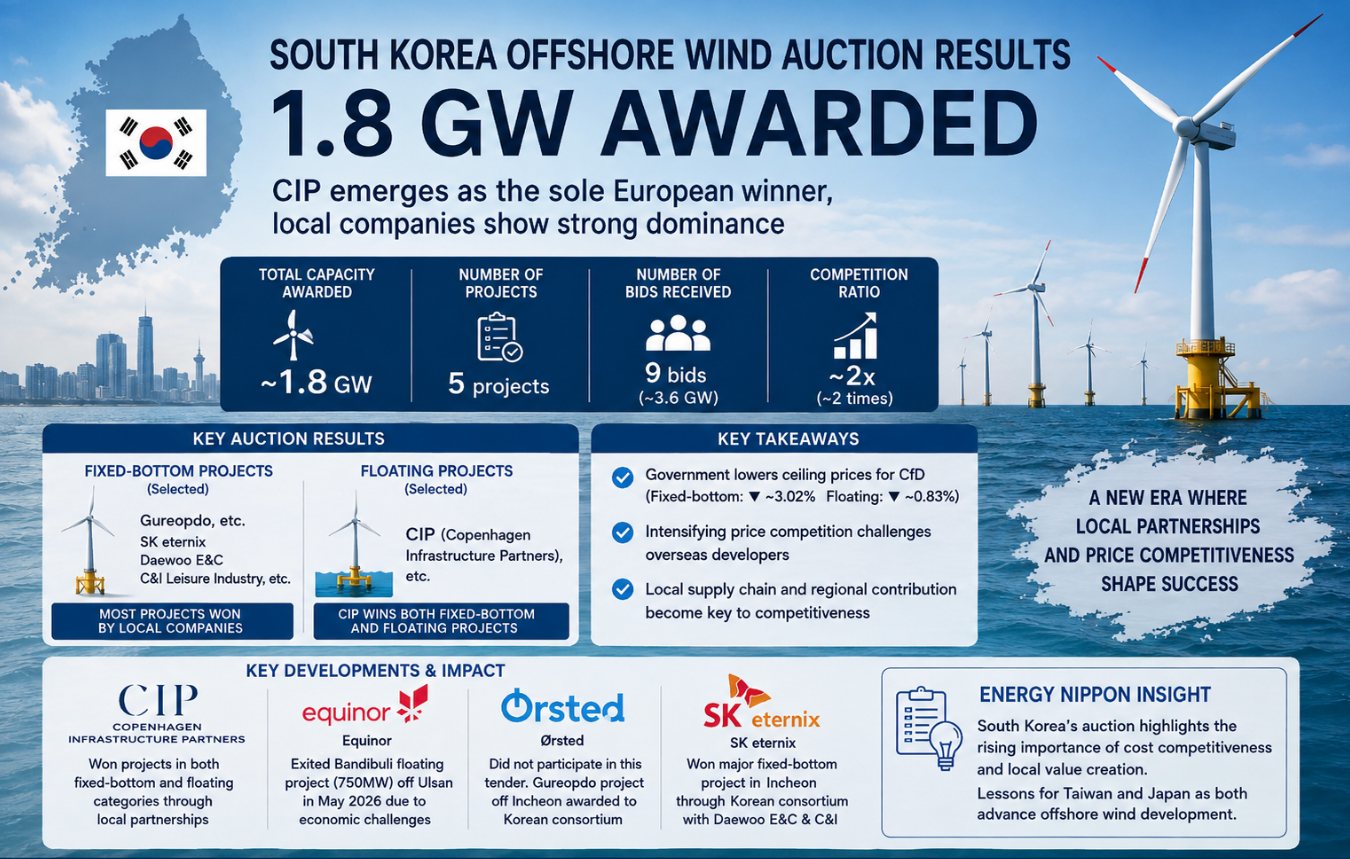
South Korea has awarded five offshore wind projects with a combined capacity of around 1.8 GW in its first-half 2026 tender, with domestic developers taking the majority of the capacity while Copenhagen Infrastructure Partners (CIP) emerged as the only European developer to secure projects.
The Danish infrastructure investor won projects in both the fixed-bottom and floating wind categories, maintaining a foothold for European capital in a tender otherwise dominated by South Korean players.
The results highlight a broader shift in South Korea’s offshore wind market, where local partnerships, supply-chain strategies and cost competitiveness are becoming increasingly important as international developers face mounting pressure from higher financing and construction costs.
According to the Korea New & Renewable Energy Center (KNREC), nine projects with a combined capacity of approximately 3.6 GW participated in the tender, representing roughly twice the capacity ultimately awarded.
The bidding round covered both fixed-bottom and floating offshore wind projects and attracted competition from domestic developers as well as projects backed by international infrastructure investors.
European developers face tougher economics
The tender comes as several major European offshore wind developers reassess their exposure to the South Korean market.
Norwegian energy group Equinor announced in May that it would discontinue development of its 750 MW Bandibuli floating offshore wind project off Ulsan, citing difficulties in securing sufficient commercial viability for the project.
Rising equipment and construction costs, higher interest rates and increasingly competitive tender conditions have placed pressure on project economics across the offshore wind sector.
South Korea has also lowered ceiling prices under its offshore wind tender framework, further increasing pressure on developers to reduce procurement, construction and financing costs.
Danish offshore wind major Ørsted did not participate in the latest tender.
In waters off Incheon, where Ørsted has spent years developing offshore wind opportunities, the fixed-bottom Gureopdo project was instead awarded to a South Korean consortium comprising SK eternix, Daewoo Engineering & Construction and C&I Leisure Industry.
The result underscores the growing ability of domestic developers to compete for large-scale offshore wind projects in their home market.
Local supply chains become a competitive advantage
Changes to South Korea’s auction framework have also intensified price competition.
For the 2026 tender, the government lowered the ceiling price for fixed-bottom offshore wind by around 3.0% from the previous year, while the ceiling for floating offshore wind was reduced by approximately 0.8%.
The tighter pricing environment is forcing developers to seek further reductions in equipment procurement, construction and financing costs.
International developers that rely heavily on European equipment and supply chains may therefore face disadvantages compared with projects that can source more components and services domestically.
CIP, however, has steadily expanded its partnerships with South Korean companies, including cooperation with the SK Group, while building stronger links with the country’s offshore wind supply chain.
That localisation strategy is becoming increasingly important.
South Korea’s offshore wind tenders are assessed not only on price, but also on factors including contributions to domestic industry, supply-chain development and benefits to local economies. The ability to establish partnerships with Korean companies can therefore have a direct impact on a project’s competitiveness.
A changing competitive landscape
The latest tender offers a glimpse into a broader shift taking place across the global offshore wind industry.
European developers have traditionally held an advantage in international markets due to their extensive project portfolios, technical expertise and experience in developing large-scale offshore wind farms.
But that advantage is being tested as inflation, higher interest rates and rising construction costs reshape project economics.
At the same time, governments are increasingly designing offshore wind auctions around a combination of price competitiveness, local industrial development and supply-chain resilience.
As a result, technical expertise alone may no longer be enough to win projects. The ability to establish competitive local supply chains, work with domestic partners and demonstrate tangible economic benefits to host regions is increasingly becoming part of the competitive equation.
South Korea’s latest auction could therefore offer lessons beyond its domestic market.
Taiwan is moving ahead with its Round 3 offshore wind development programme, while developers are placing greater emphasis on project bankability and returns amid rising costs. Japan is also reviewing its offshore wind auction framework as it seeks to balance project viability with industrial development and regional economic benefits.
For both markets, South Korea highlights a central policy challenge: how to maintain competitive electricity prices and strengthen domestic offshore wind industries without discouraging the international capital and expertise needed to deliver large-scale projects.
Sources: Equinor, South Korean government / Ministry of Climate, Energy and Environment (MCEE), WindTAIWAN