Japan Plans to Raise Offshore Wind Revenue Support Cap to 3.5 Times Previous Level
2026/07/20
Japan plans to sharply increase revenue support for offshore wind projects, adding financial relief to a broader overhaul of its auction framework as rising construction costs threaten the sector’s expansion.
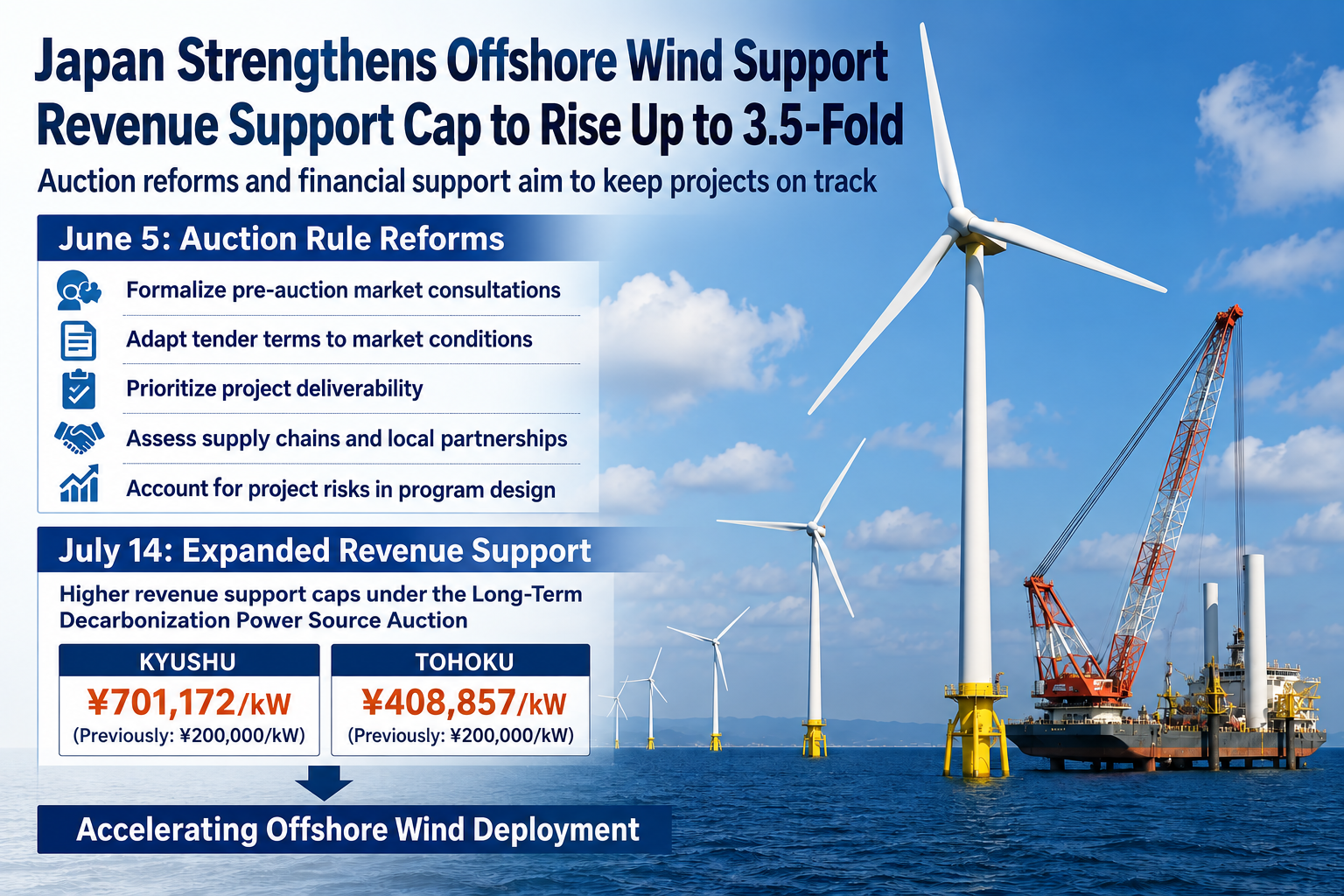
The Ministry of Economy, Trade and Industry (METI) outlined plans on July 14 to raise the ceiling under Japan’s Long-Term Decarbonization Power Source Auction to approximately ¥700,000 per kilowatt—about 3.5 times the previous ¥200,000 level.
The change would apply from the fiscal 2026 auction to projects in six offshore areas awarded in the second and third rounds of Japan’s offshore wind tenders.
The proposed increase follows revisions to project selection rules in June, signaling a coordinated effort to improve both project viability and revenue certainty.
Mitsubishi’s Exit Prompts Policy Overhaul
The reforms follow the 2025 withdrawal of a Mitsubishi Corporation-led consortium from three projects off Akita and Chiba prefectures awarded in Japan’s first offshore wind auction round.
Higher equipment and material prices, a weaker yen, rising interest rates and increased labor costs had undermined the projects’ original financial assumptions.
The withdrawal exposed weaknesses in Japan’s offshore wind development framework and prompted the government to reassess how projects are selected and supported.
Auction Rules Shift Toward Deliverability
On June 5, METI and the Ministry of Land, Infrastructure, Transport and Tourism revised the guidelines governing offshore wind tenders in general sea areas.
The changes placed greater emphasis on developers’ ability to complete projects and sustain operations over the long term, moving beyond the framework’s previous focus on price competition.
The revised guidelines provide for consultations with prospective bidders before tenders are launched, more flexible tender conditions and greater consideration of inflation and changes in the supply chain.
The policy shift reflects concern that aggressive bidding can produce low headline prices while leaving projects vulnerable to cost increases before construction begins.
Regional Caps to Improve Revenue Certainty
The proposed changes to the Long-Term Decarbonization Power Source Auction would complement those tender reforms by strengthening financial support.
METI set out regional revenue support ceilings of:
- Kyushu: ¥701,172 per kilowatt
- Tohoku: ¥408,857 per kilowatt
The regional approach would replace the previous broadly uniform ceiling of ¥200,000 per kilowatt, taking account of differences in wind conditions and capacity factors.
Actual support levels would be determined through competitive bidding. Greater visibility over future revenue is expected to help developers secure financing, although the higher ceilings would not automatically translate into equivalent payments for every project.
Government Moves to Allow Overlapping Support
Japan is also revisiting restrictions on combining support mechanisms.
The Long-Term Decarbonization Power Source Auction previously could not be used alongside the feed-in premium, or FIP, scheme.
Following the Mitsubishi-led consortium’s withdrawal, METI moved in November 2025 to allow projects awarded in the second and third offshore wind rounds to combine certain support measures.
For the planned re-tendering of the three first-round projects, the government also intends to use the FIP framework to help reduce project risk.
These changes form part of a wider effort to make offshore wind projects financeable under market conditions that have shifted substantially since the original tenders.
Structural Cost Pressures Remain
Despite the proposed increase, concerns remain among developers that the measures may still leave projects with limited financial headroom.
Japan faces several structural challenges. Its offshore wind supply chain and port infrastructure are less developed than those in Europe, while complex seabed conditions and the need to withstand typhoons and earthquakes can increase foundation and construction costs.
A shortage of skilled workers adds further pressure.
At the July 14 meeting, the government acknowledged that offshore wind developers face a business environment in which costs are difficult to forecast.
First-Round Re-Tenders Will Test the Reforms
Taken together, the June tender revisions and July revenue support proposals point to a broader shift in Japan’s offshore wind policy: greater weight is being placed on whether projects can be built and operated successfully over their full life cycle.
The earlier framework emphasized lower electricity prices through competition. A prolonged rise in global construction costs has weakened the assumptions underpinning that approach.
Whether the latest measures will be enough to restore investor confidence remains uncertain. Domestic supply chains, port capacity, workforce development and insurance arrangements will also influence investment decisions by international developers and turbine manufacturers.
The planned re-tendering of the three first-round projects will provide a key test of whether Japan’s revised framework can turn policy support into viable offshore wind development.
Sources: Ministry of Economy, Trade and Industry; Nikkei.