Japan Selects Ricoh, Choshu Industry for Perovskite Solar Manufacturing Support
2026/10/27
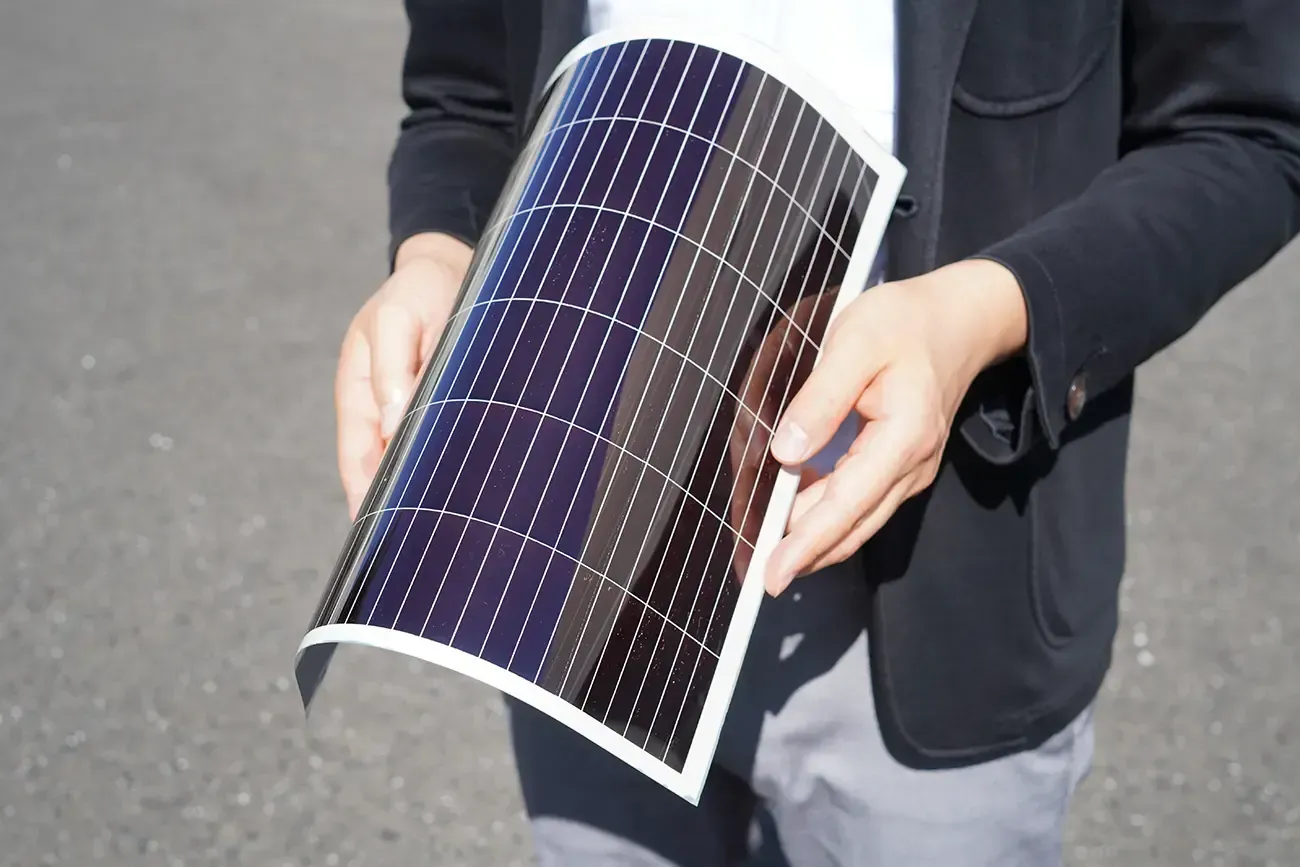
Perovskite solar cells produced by Ricoh using inkjet printing technology. (Source: Ricoh)
Japan has selected Ricoh and Choshu Industry for subsidies to expand domestic production of perovskite solar cells, adding momentum to efforts to bring the next-generation photovoltaic technology to market.
The selections, published October 27 under the Ministry of Economy, Trade and Industry’s GX Supply Chain Development Support Program, cover Ricoh’s film-type solar cells and Choshu Industry’s tandem solar cells. Together, the companies’ listed subsidy applications total approximately ¥13.65 billion.
Ricoh’s project in Natori, Miyagi Prefecture, lists eligible project costs of ¥29.58 billion and a subsidy application of ¥9.86 billion. Choshu Industry’s project in Sanyo-Onoda, Yamaguchi Prefecture, covers solar cell and module production, with project costs of approximately ¥7.59 billion and a subsidy application of approximately ¥3.79 billion.
The figures are application amounts rather than final disbursements. The program documents note that Ricoh’s actual subsidy may differ from the listed amount, while Choshu Industry’s allocation could increase through additional applications.
Nikkei reported October 26 that the government was expected to provide roughly ¥100 billion to the two companies over four years through fiscal 2029. That longer-term figure is separate from the amounts listed in the latest selection documents, which do not explain how the two figures relate.
Different Technologies Target Different Markets
Ricoh is developing film-type perovskite solar cells using inkjet printing and materials expertise drawn from its office equipment business. Its manufacturing approach forms the cells’ functional layers without laser processing or vacuum-based processes, aiming to improve productivity and lower costs.
The company is also working with Daiwa House Industry and NTT Anode Energy to develop manufacturing, installation and electrical system design together. Potential applications include warehouse roofs and data center exterior walls. Under a demonstration plan announced in 2025, the partners aim to achieve annual manufacturing capacity of at least 300 megawatts and an electricity generation cost of ¥14 per kilowatt-hour in fiscal 2030.
Choshu Industry is pursuing tandem cells that combine perovskite and silicon. In February 2026, the company announced its selection for a separate Green Innovation Fund project administered by Japan’s New Energy and Industrial Technology Development Organization, or NEDO.
That project targets modules measuring at least one square meter, with conversion efficiency of 30% or higher and durability of at least 20 years by fiscal 2030. These remain development targets, rather than demonstrated specifications for mass-produced products.
Manufacturers Move Toward Commercial Supply
Other Japanese manufacturers are also advancing their own production plans.
Sekisui Chemical and Sekisui Solar Film announced the launch of their SOLAFIL film-type perovskite solar business in March 2026. Initial products are designed for metal roofs. Supply will remain limited by existing production equipment in fiscal 2026, with a 100-megawatt production line planned for fiscal 2027.
Panasonic Holdings said October 20 that it would begin full-scale production of glass-type perovskite solar cells in Nagahama, Shiga Prefecture, in April 2029, a year earlier than previously planned. It began selling initial production units in September 2026 to build installation and operating experience ahead of the larger rollout. The technology targets building-integrated applications such as windows and facades.
Deployment Support Aims to Build Demand
Japan is also supporting early installations. On October 15, the Environment Ministry opened a second application round for its fiscal 2026 perovskite solar deployment program, with applications due by noon on November 20.
The program supports installations with potential for replication across similar buildings, seeking to reduce early-stage generation costs and establish sustained demand.
The companies’ development programs point to a broader commercialization challenge: expanding factory capacity must be accompanied by progress in durability, installation methods and electrical system design. For perovskite solar to achieve wider adoption, manufacturers will need to demonstrate reliable performance and competitive economics across production, installation and operation.