Fuel Cells Move Beyond Demonstration Stage as Taiwan Eyes Commercial Deployment for AI and Semiconductor Industries
2026/06/19
Following the focus on zero-carbon transportation in the previous issue, attention is now turning to fuel cells, a key technology in the hydrogen economy that is increasingly moving from pilot projects toward commercial deployment.
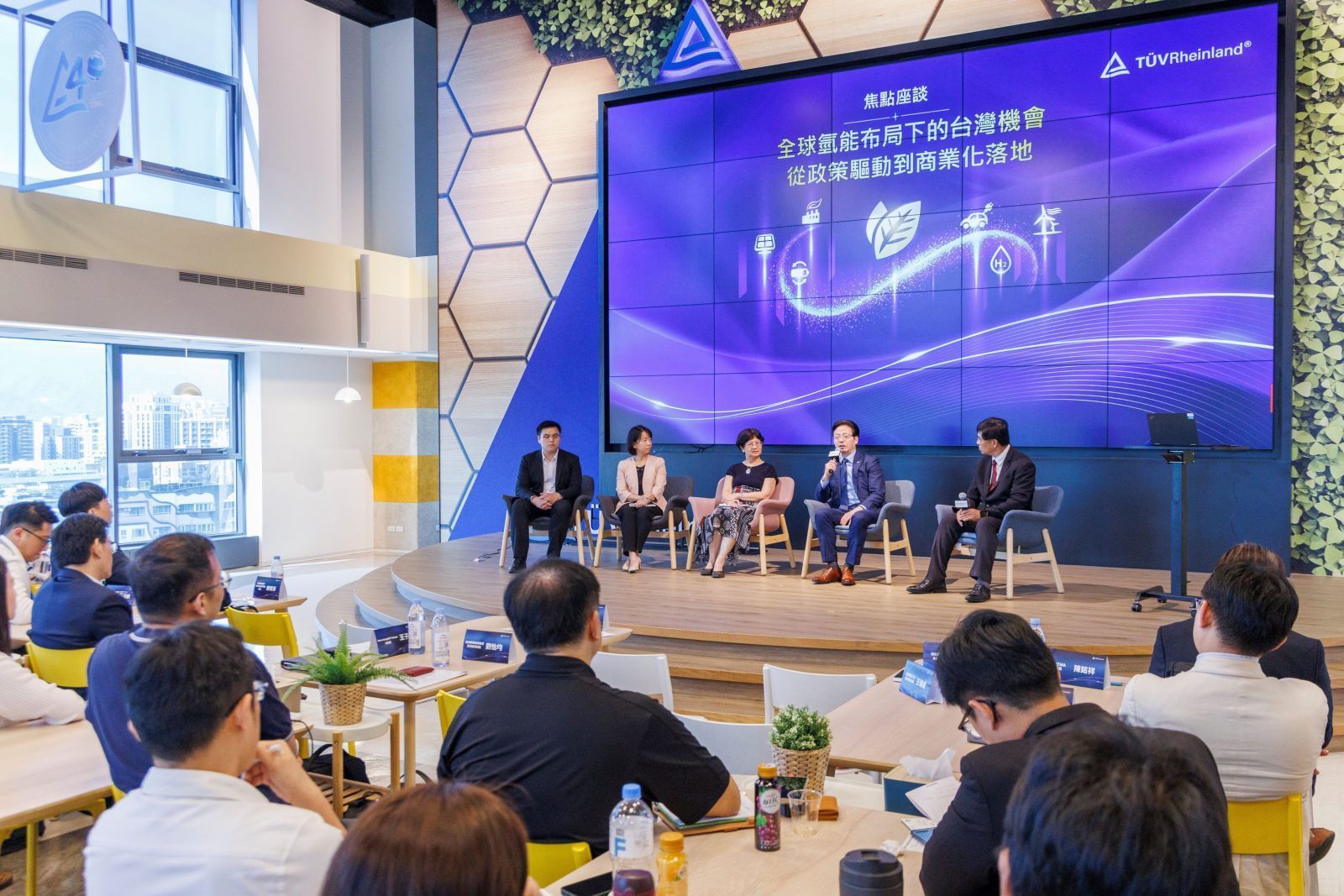
German testing, inspection and certification organization TÜV Rheinland recently hosted a forum titled “Positioning for the New Hydrogen Economy: Market Trends and Certification Requirements for Fuel Cell Power Generation Systems.” The event brought together experts from Taiwan’s Energy Administration, the Australian Office, BloombergNEF, and the Industrial Technology Research Institute (ITRI) to discuss policy incentives, international investment opportunities, market entry strategies, and safety certification requirements shaping the future of fuel cell power generation.
Commercial Adoption Gains Momentum
Fuel cells have long been associated with demonstration projects and niche transportation applications. However, Taiwan is accelerating the commercialization of stationary fuel cell power generation systems as part of its broader energy transition strategy.
Speaking at the forum, Tsai Hsiu-fen, Director General of the Oil and Gas Development and Management Division at Taiwan’s Energy Administration, said the government is prioritizing hydrogen-based distributed power generation with clear commercial applications. AI-related industries, data centers, semiconductor manufacturers, and other energy-intensive sectors have been identified as key deployment targets.
The initiative signals that fuel cell power generation systems are moving beyond laboratory research and pilot projects toward large-scale commercial applications.
Amid growing pressure from global supply chains to decarbonize, Taiwan has designated hydrogen as one of its 12 key national strategic industries. The government has outlined a roadmap under which hydrogen is expected to account for 9% to 12% of the country’s power generation mix by 2050.
To support this goal, the Energy Administration has expanded incentives under its subsidy program for stationary fuel cell power generation systems. The revised scheme now includes projects exceeding 2 MW, with subsidies of up to NT$70,000 per kilowatt available to qualifying installations. The policy aims to increase self-generation capacity among industrial users and accelerate large-scale commercial deployment.
Australia Emerges as Strategic Hydrogen Partner
For Taiwan, which imports approximately 97% of its energy supply, securing reliable hydrogen sources remains a critical challenge.
At the forum, Liu Yi-chun, Senior Investment Director at the Australian Office, highlighted Australia’s ambitious hydrogen development strategy. The Australian government has committed more than A$10 billion in direct support for hydrogen initiatives, while total renewable energy-related incentives exceed A$40 billion.
Australia is targeting annual green hydrogen production of between 15 million and 30 million tonnes by 2050, positioning itself as a major future supplier to international markets.
The country’s abundant solar and wind resources, combined with vast land availability, provide favorable conditions for large-scale green hydrogen and green ammonia production. At the same time, domestic demand for decarbonization solutions in long-haul transportation, backup power systems, and mining operations is expected to grow rapidly.
These developments could create mutually beneficial opportunities for Taiwanese companies specializing in fuel cells, hydrogen technologies, and related equipment, potentially strengthening industrial cooperation between Taiwan and Australia.
Safety Certification Becomes a Key Requirement
Despite growing market opportunities, safety remains one of the most important challenges facing the hydrogen industry.
Hydrogen molecules are extremely small and highly flammable, making leak prevention and risk management critical throughout the supply chain. From transporting hydrogen from Australia to Taiwan to integrating it into Proton Exchange Membrane Fuel Cells (PEMFC) for mobility applications or Solid Oxide Fuel Cells (SOFC) for large-scale power generation, robust safety measures are required at every stage.
Huang Szu-ming, Senior Project Engineer for Industrial Services and Cybersecurity at TÜV Rheinland, outlined key considerations for explosion protection and safety assessment in fuel cell power systems.
These include hazardous area classification, ignition source control, ventilation and dilution design, equipment suitability assessments, gas detection systems, and emergency shutdown mechanisms.
As fuel cell technologies enter the commercial phase, compliance with international safety standards is becoming increasingly important. Industry experts noted that third-party certification can help reduce operational risks while improving investor confidence and market acceptance.
-----------------------------------------------------------------------------------------
The rapid expansion of AI infrastructure and semiconductor manufacturing is driving unprecedented demand for reliable, low-carbon electricity. In Taiwan, stationary fuel cells are emerging as a potential solution capable of delivering both energy security and decarbonization benefits.
However, the commercialization of fuel cells extends far beyond the power generation equipment itself. Success will depend on the development of integrated hydrogen value chains covering production, transportation, storage, and end-use applications.
While partnerships with resource-rich countries such as Australia could help address future hydrogen supply needs, safety certification and compliance with international standards are increasingly becoming key competitive differentiators. As the hydrogen economy evolves, companies that can demonstrate both technological capability and operational reliability are likely to be best positioned to capture emerging market opportunities.