BP Moves to Sell 25% Stake in Japan’s Yuza Offshore Wind Project as Global Portfolio Review Reaches Asia
2026/7/9
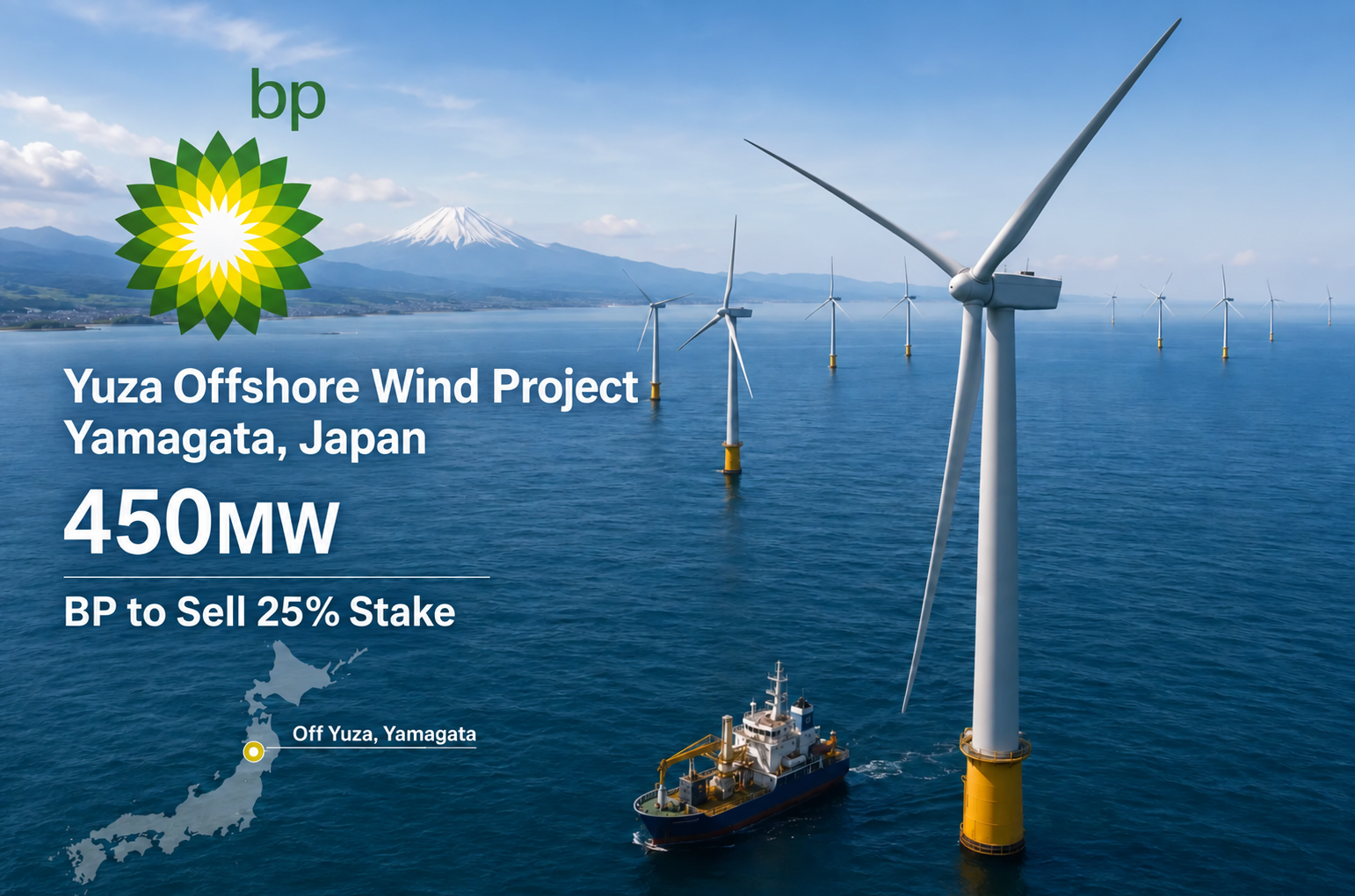
BP is in talks to sell its 25% stake in an offshore wind project off the coast of Yuza in Yamagata Prefecture, extending a broader restructuring of its low-carbon portfolio to the Japanese market.
The proposed divestment follows BP’s withdrawal from a major green hydrogen development in Australia and the sale of its US onshore wind portfolio. Together, the moves point to a shift in capital allocation under the energy major’s new leadership, with a greater emphasis on returns, financial discipline and higher-value assets.
Rather than representing a decision driven solely by conditions in Japan, the planned sale appears to form part of BP’s wider effort to streamline its global portfolio.
Global restructuring gathers pace
In July 2025, BP announced plans to withdraw from the Australian Renewable Energy Hub, or AREH, a large-scale green hydrogen and renewable energy project estimated to require around $36 billion in investment. The company moved to relinquish its 63.57% interest in the development.
During the same month, BP also agreed to sell its US onshore wind business, comprising 10 operating wind farms across seven states with a combined generating capacity of approximately 1.7GW.
The restructuring accelerated in 2026 following the appointment of Meg O’Neill as chief executive in April.
In June, O’Neill launched a group-wide reorganization that eliminated BP’s standalone low-carbon energy division and integrated its wind and solar operations into the company’s technology organization. The changes were designed to simplify the corporate structure and direct resources towards businesses capable of generating stronger returns.
O’Neill said the restructuring was intended to create a “simpler, stronger and more valuable BP”.
Although BP continues to identify offshore wind and hydrogen as important elements of the energy transition, the company has placed renewed emphasis on its upstream oil and gas operations. The shift reflects changing priorities in how the group evaluates and allocates capital.
The proposed sale of the Yuza stake can therefore be viewed in the same context as BP’s recent divestments in Australia and the United States.
Challenging economics for offshore wind
The review comes as offshore wind developers worldwide grapple with higher interest rates, inflation, supply-chain disruption and rising construction costs. These pressures have weakened project economics and prompted international energy companies to reassess their low-carbon investments.
Japan’s offshore wind market is facing many of the same challenges.
The Japanese government has introduced a series of reforms since 2024 to improve project viability, including revisions to auction rules and measures intended to reflect changes in development costs. However, projects awarded under earlier support frameworks generally have less flexibility to absorb sharp increases in equipment, construction and financing costs.
A weaker yen has added further pressure by raising the cost of imported turbines and other components.
The Yuza offshore wind project was selected in Japan’s third offshore wind auction in December 2024. The consortium, led by Marubeni, also includes Kansai Electric Power, Tokyo Gas and local construction company Marutaka. Commercial operations are currently targeted for June 2030.
BP is believed to hold approximately 25% of the project company, making it the second-largest shareholder after Marubeni. The remaining Japanese partners are expected to continue developing the project, potentially through a revised ownership structure.
While BP’s global portfolio strategy appears to be the principal factor behind the planned divestment, deteriorating offshore wind economics in Japan may also have influenced the decision.
Japan enters a more selective phase
BP’s move should not necessarily be interpreted as a complete withdrawal from Japan’s offshore wind market. It is better understood as part of a global portfolio rebalancing by one of the world’s largest energy companies.
Nevertheless, the potential sale highlights a broader shift in Japan’s offshore wind sector.
As international investors become more selective, Japanese companies may need to assume a larger role in project development, financing and long-term operations. Their ability to secure capital and manage increasingly complex construction and supply-chain risks could become critical to the market’s continued expansion.
Japan’s offshore wind industry is moving beyond an initial phase focused primarily on deployment targets and capacity growth. Project economics, financing resilience and execution capability are now becoming equally important.
BP’s review of its Yuza stake is therefore more than an isolated corporate decision. It illustrates how the global energy transition is entering a new phase—one in which investment discipline and commercial viability are being weighed more carefully alongside decarbonization ambitions.
Sources: Yahoo!Finance, BusinessChief。, WindTAIWAN